
Most failed rural driveways failed underground, long before anyone noticed. Base, drainage, and crown are what separate a lane that lasts fifteen years from one you regrade every spring.
A gravel driveway on Midwest clay is a drainage structure that happens to carry vehicles. Treat it as a drainage structure and it lasts. Treat it as a layer of rock and you will be adding stone every year forever.
Why they fail here
Indiana and Ohio clay does two things that destroy roadbeds.
It holds water. Clay does not drain. Water that gets into the base stays there.
It freezes and thaws repeatedly. Not one hard freeze and one thaw — dozens of cycles between December and March. Each one lifts the surface and drops it again. Water in the base turns to ice, expands, breaks the structure apart, then thaws and leaves voids. That is frost heave, and it is why a driveway that looked fine in November is a washboard in March.
Get the water out and the freeze-thaw cycle has much less to work with.
Building it right
1. Strip the organics. Topsoil, roots, and vegetation have to come out of the roadbed. Organic material decomposes and settles, and a driveway built on it will develop soft spots. Down to firm subgrade — usually six to twelve inches on Midwest ground.
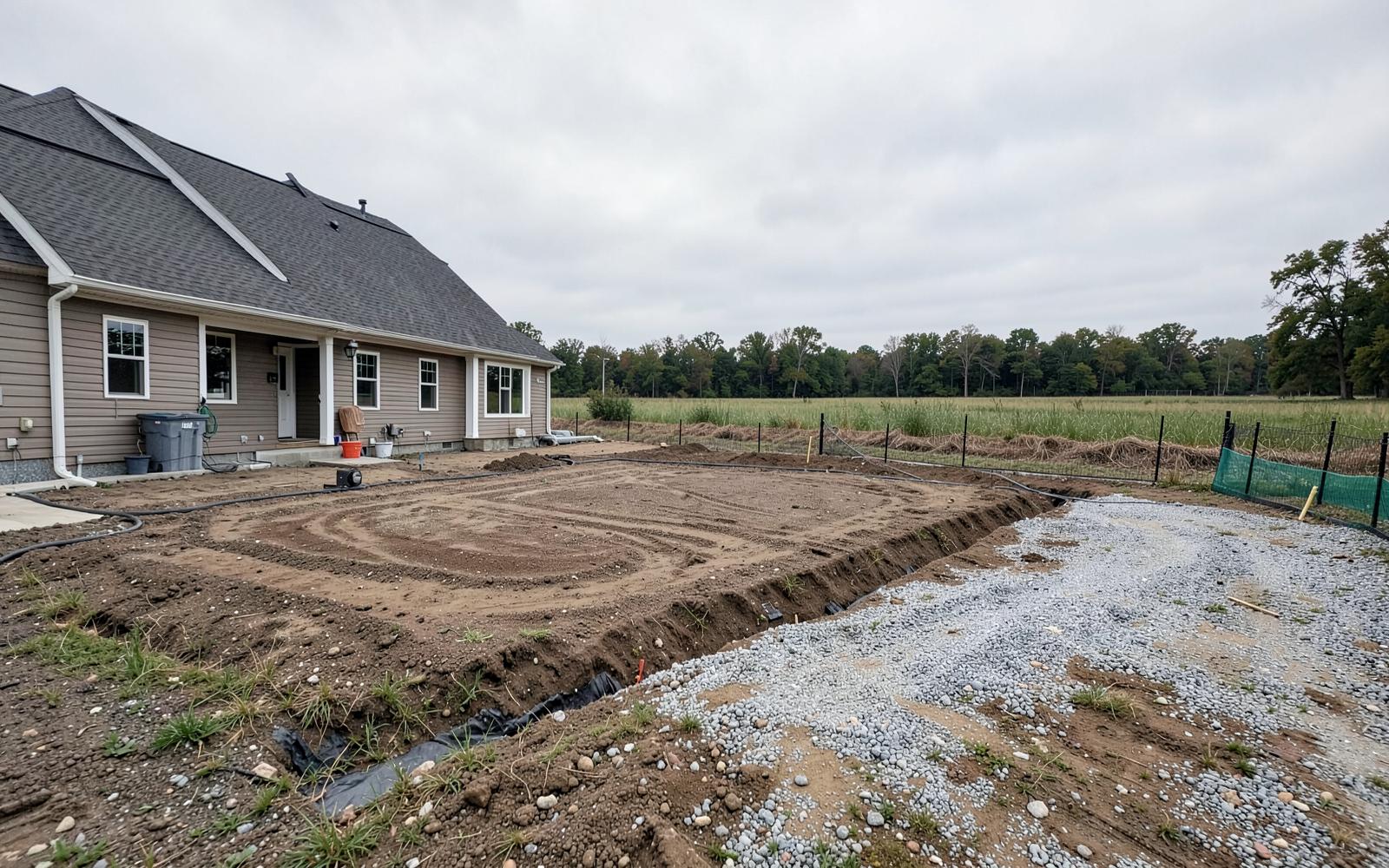
2. Shape the subgrade with crown. Before any stone, the subgrade itself should be crowned — higher in the center, sloping to both sides. If the base under the rock is flat or dished, water pools there permanently no matter what you put on top.
3. Consider geotextile fabric. On soft or wet subgrade, a layer of woven fabric between soil and stone separates the two and spreads load. It keeps your base stone from slowly disappearing into the clay. On questionable ground it is one of the highest-value dollars in the whole build.
4. Base course. Large angular stone — commonly a #2 or similar coarse aggregate — six to ten inches compacted. Angular, not round: crushed stone locks together, river gravel rolls. This layer is the structure.
5. Compact in lifts. Placing ten inches at once and rolling the top does not compact the bottom. Place in lifts of three to four inches and compact each one.
6. Surface course. Smaller dense-graded aggregate — a 53s or similar crusher-run with fines — three to four inches. The fines are what let the surface bind rather than scatter.
7. Crown the finished surface. Roughly a quarter inch of fall per foot from center to edge. Enough to shed water, not so much that vehicles feel it.
Drainage is the whole ballgame
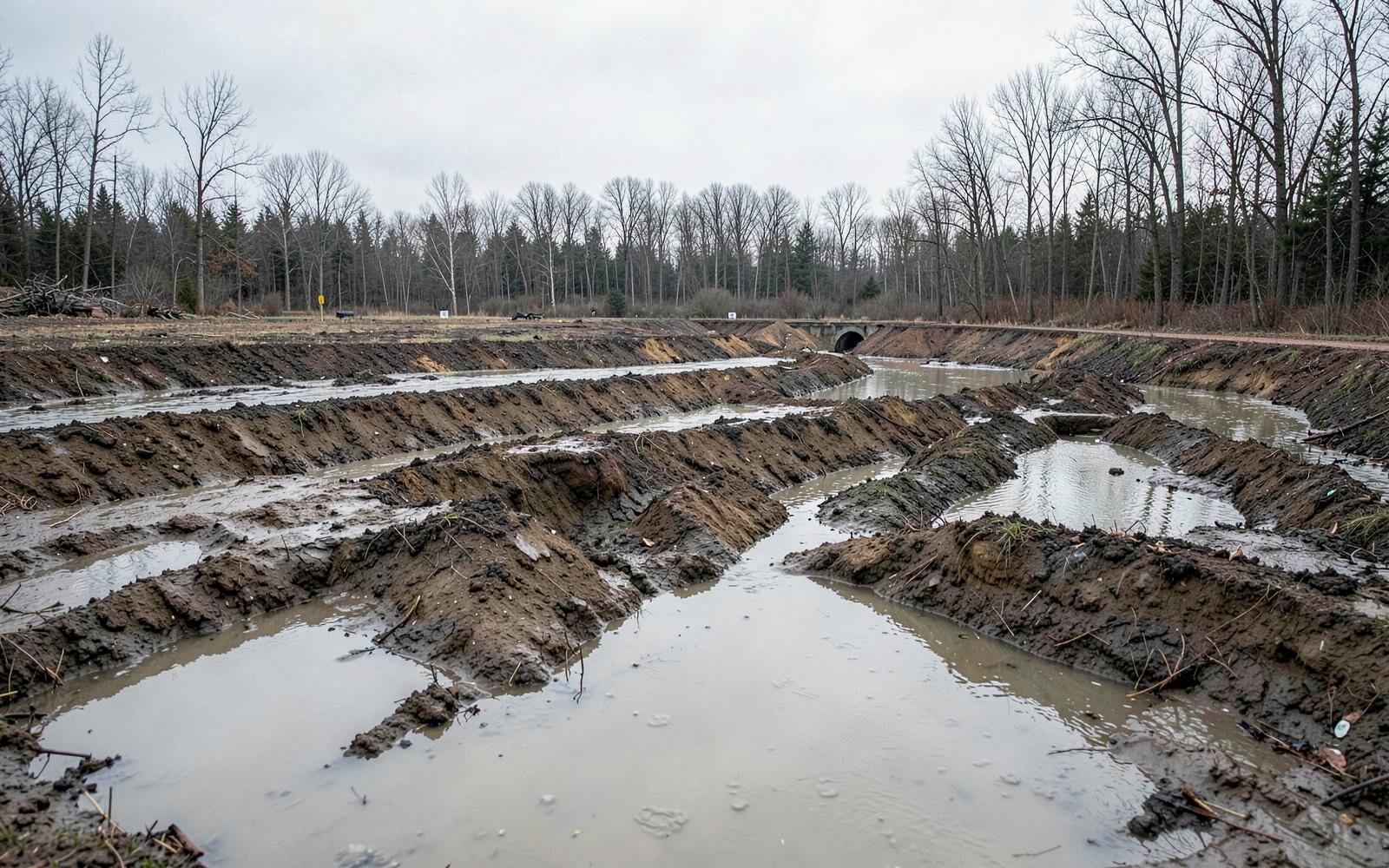
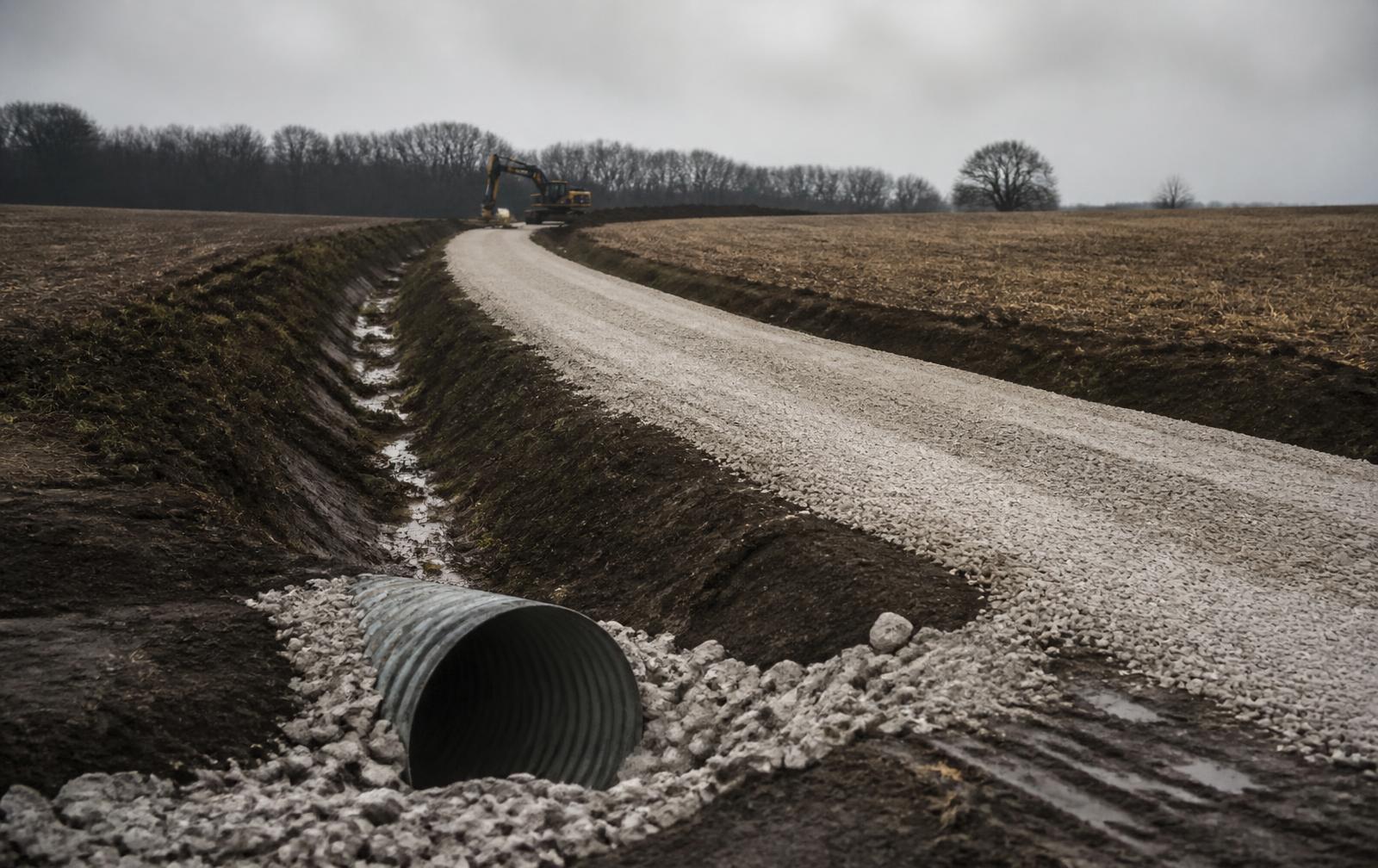
Ditches on both sides. Not decorative — sized to carry what comes off the road and the ground above it, with a continuous grade to somewhere water can actually go.
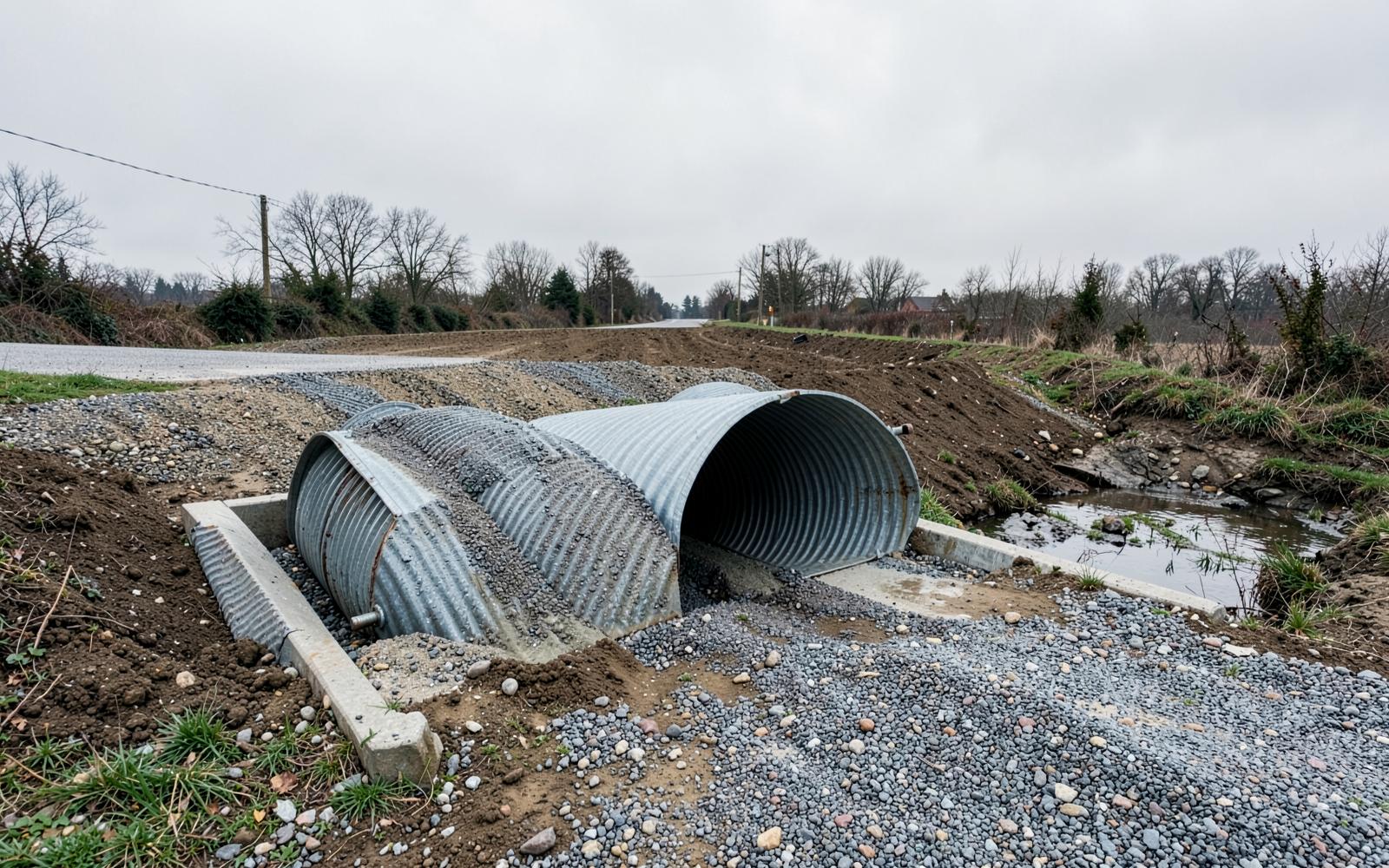
Culverts wherever water crosses. Sized for real storm flow, not average flow. An undersized culvert becomes a dam, and a dam takes the road with it.
A road approach at the county road. Nearly every county in Indiana and Ohio requires a permit for a new approach onto a public road, with specifications for the culvert size and how it ties in. Check with the county highway department before you build, not after.
Do not fight the water. Where the natural drainage wants to run, put a crossing there rather than trying to route it somewhere it does not want to go.
The winter-specific details
Plan for plowing. A driveway you cannot plow is a driveway you cannot use in February. Give the plow room to push snow to the sides, and mark the edges — a plow truck cannot see a gravel edge under six inches of snow, and finding it costs you material every year.
Watch shaded stretches. Under a tree canopy or on a north-facing bank, ice forms first and leaves last. Sometimes worth wider clearing to let sun reach the surface.
Avoid holding water at low points. Anywhere water stands is where ice forms and where the base breaks up first.
What it costs
Highly variable — driven by length, width, how much cut and fill the route needs, subgrade condition, culvert count, and aggregate haul distance. A short flat run over firm ground is a very different number from a quarter mile with two crossings and a hill.
The reliable pattern: money spent on base and drainage saves multiples over the life of the lane. Money saved by thinning the base gets spent again every spring.
Maintenance that actually works
- Grade to restore the crown once or twice a year, not just to smooth the ruts
- Keep ditches open — a ditch full of sediment is not a ditch
- Add material to the surface course as it wears, before the base is exposed
- Fix soft spots when they appear rather than driving them into a hole
Planning a driveway or lane? We can walk the route and tell you where the water is going to want to go.