
One acre is the number that changes everything. Here is the state stormwater rule, the agricultural and forestry exemptions, and the county-level permits people forget.
Most Indiana landowners clearing a few acres are surprised to learn a state permit may be involved. Most contractors clearing a few acres are not. Here is the landscape.
This is general orientation, not legal advice. Requirements change and vary by location — confirm with the agencies below before you start.
The one-acre threshold
Indiana''s Construction Stormwater General Permit (CSGP), administered by the Indiana Department of Environmental Management (IDEM), applies to construction activity that disturbs one acre or more of land.
It also catches smaller projects that are part of a larger common plan of development or sale — meaning a one-third-acre lot inside a subdivision can be covered even though the lot itself is under an acre.
If it applies, the site owner must obtain coverage before land-disturbing activity begins, which involves submitting a Notice of Intent and having a stormwater pollution prevention plan in place.
Contact: IDEM Stormwater Program, Stormwat@idem.IN.gov or (317) 232-8603.
The exemptions that matter to landowners
Agriculture. Routine farming — tillage, planting, cultivation, harvesting, and pasture renovation — is excluded. But constructing barns, farm roads, waste lagoons, ponds, and wetlands on agricultural ground does require coverage.
Forestry. Actual forest harvesting and skid roads are exempt. However, staging areas, access roads, and haul roads count toward the disturbed acreage. And critically, forest harvesting done in preparation for land development loses the exemption.
That last point catches people. Clearing timber because you are going to build is not forestry, it is site development.
Also excluded: coal mining, oil and gas exploration, and certified-closure landfills.
County and local permits
State stormwater is only one layer. Depending on where you are and what you are doing, expect some combination of:
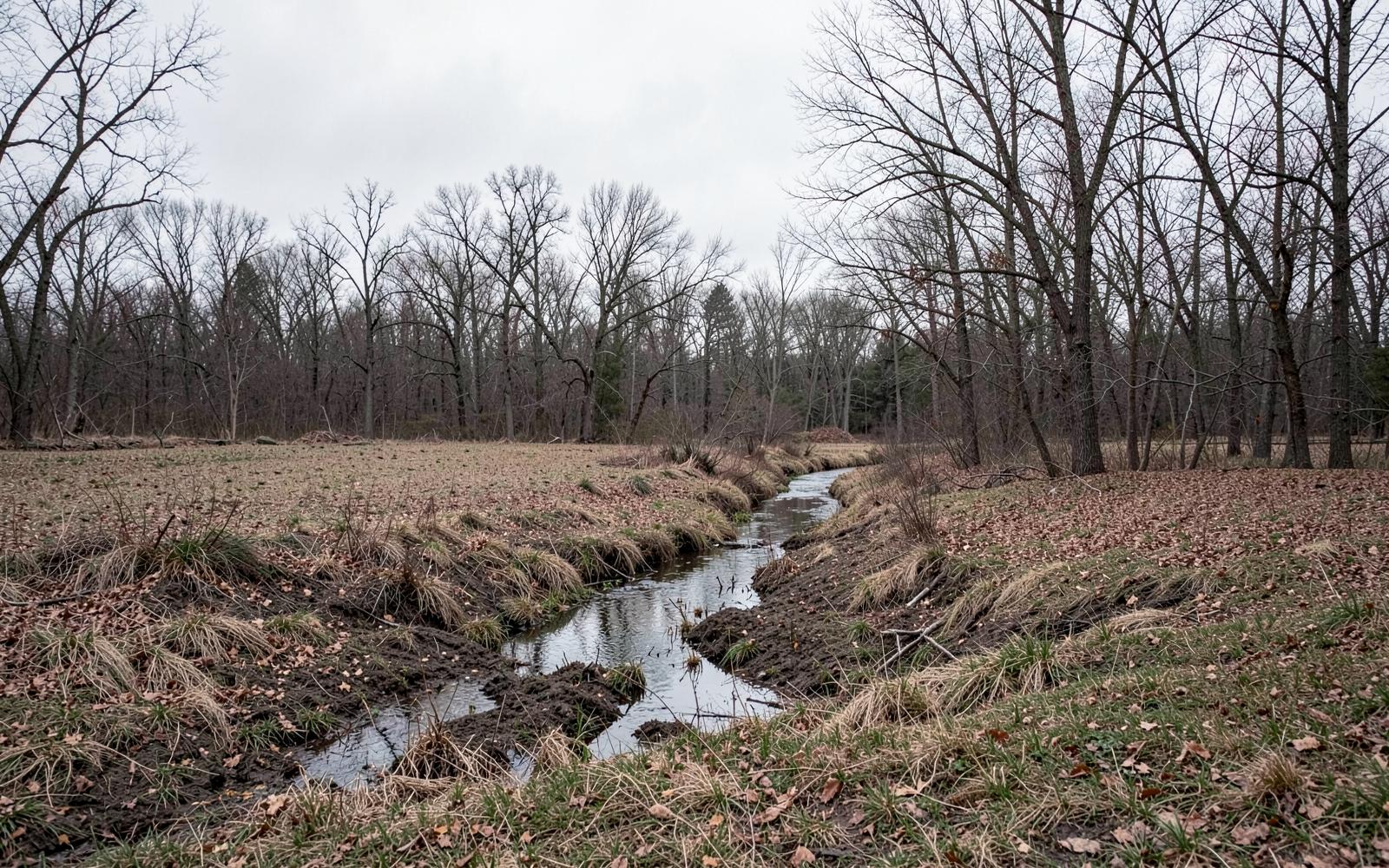
County drainage / surveyor. If a regulated or legal drain crosses the property, there are protected easements with restrictions on building, filling, and planting. The county surveyor holds the maps and the drainage board has jurisdiction over alterations.
Floodplain. Work in a mapped floodplain generally requires review, often involving the Indiana DNR Division of Water as well as the county.
Road approach. Nearly every county requires a permit to connect a private drive to a county road, with specifications for culvert size, invert elevation, width, and sight distance. Contact the county highway department. On a state route, contact the INDOT district office.
Open burning. Rules vary by county and by season, and burn bans appear regularly. Check with your county and with IDEM before planning to burn cleared material. This is a strong argument for mulching in place instead.
Zoning and building. Your county or municipal planning office governs what you can put on the ground.
Local stormwater ordinances. Many Indiana municipalities and MS4 communities have their own requirements that are stricter than the state minimum.
Utility locates
Call 811 before any digging. Free, legally required, and the alternative is expensive and potentially dangerous. This applies to grubbing, excavation, post holes, and culvert installation — not to surface mulching, but if there is any chance of ground disturbance, make the call.
Wetlands and waters
Work in wetlands or streams may involve federal Clean Water Act jurisdiction through the U.S. Army Corps of Engineers, plus state authority. Wetland regulation has been an area of significant legal change in recent years. If you have wet ground you suspect might qualify, get it evaluated before clearing rather than after.
Practical sequence
- Call the county planning and highway departments and describe your project
- Call the county surveyor if any drainage feature crosses the property
- Determine your total disturbed acreage — including access and staging
- If it is an acre or more and not exempt, start the IDEM CSGP process early
- Call 811 before any digging
- Get erosion controls in before major earthwork
The practical shortcut
Call your county first. County staff deal with these projects constantly and will usually tell you plainly which permits your specific situation triggers, including the state ones. It is a ten-minute call that prevents most problems.
A contractor working regularly in your county should also know the local requirements and who pulls what. Ask during the quote.
Planning a clearing project in Indiana? We work within county and state requirements and can help sort out what applies.
Source: IDEM — Applicability of the Construction Stormwater General Permit