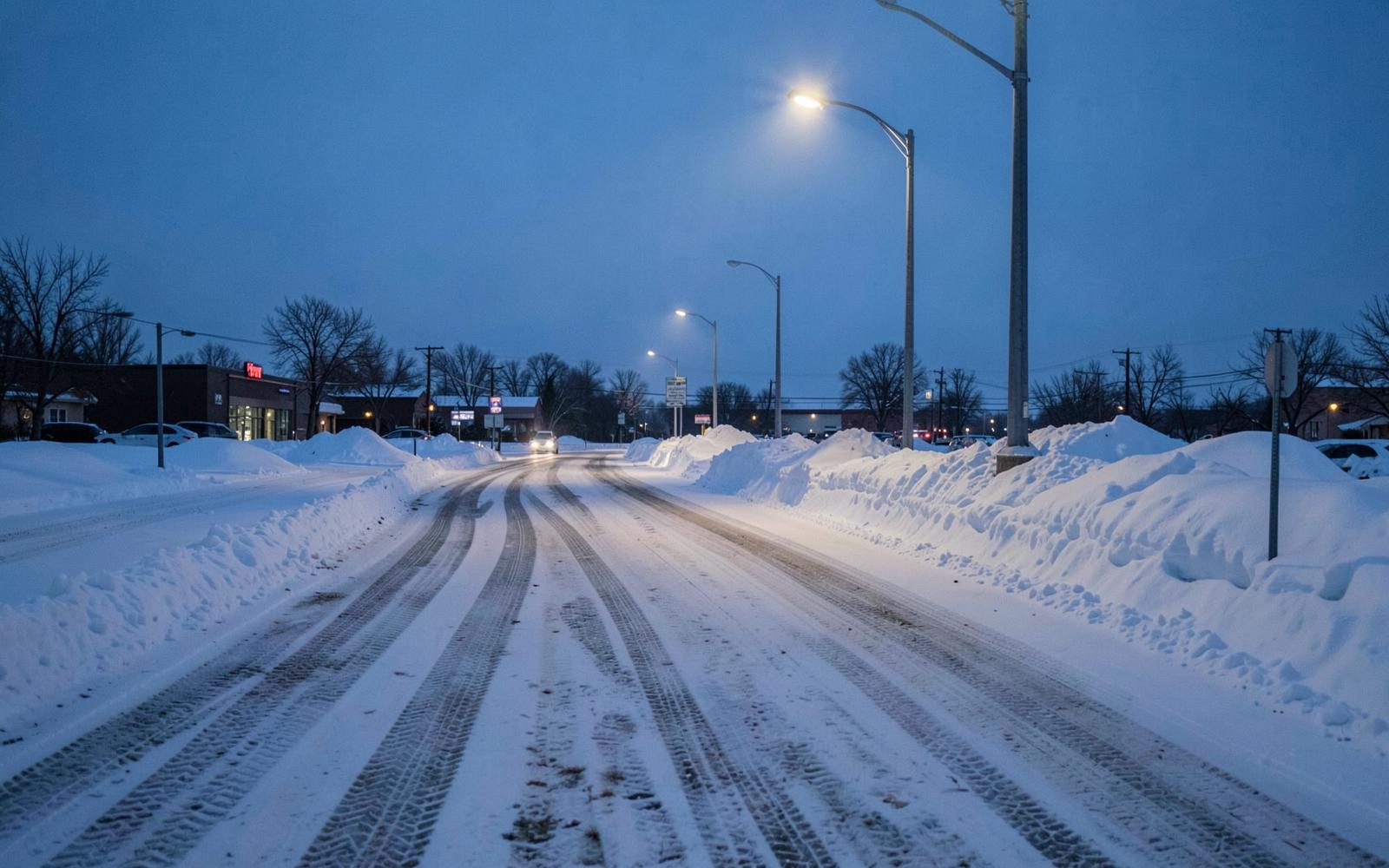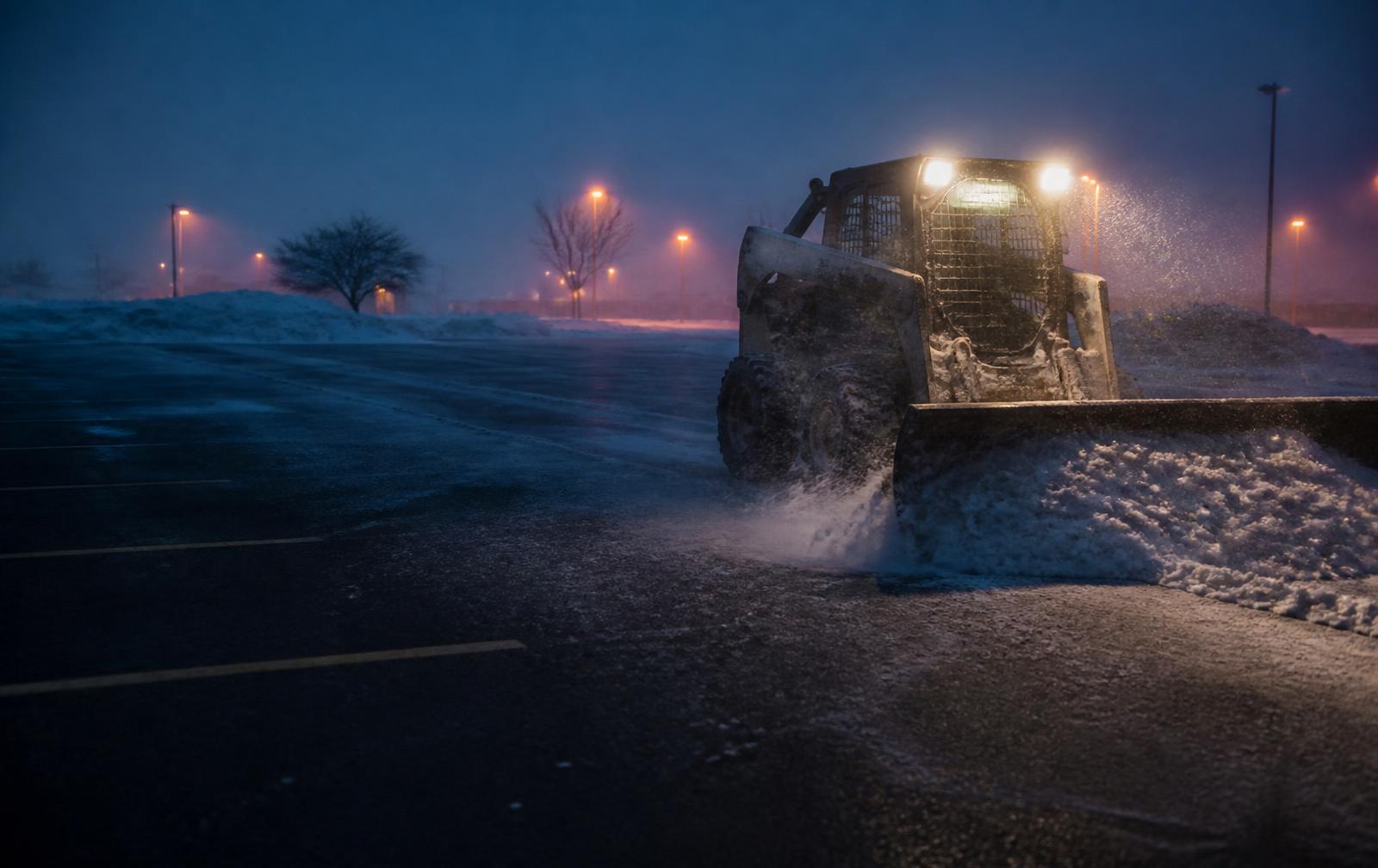

Rock salt stops working well before the coldest nights of an Indiana winter. Here is what is actually happening on your pavement and what to use instead.
More Midwest winter liability comes from ice than from snow. Ice events are harder to manage, arrive with less warning, and are where slip-and-fall claims come from.
Understanding the chemistry helps you buy the service properly.
How de-icers actually work
They lower the freezing point of water. Salt dissolves into brine, and that brine freezes at a lower temperature than plain water — which is what breaks the bond between ice and pavement so it can be plowed or scraped off.
Two consequences follow from this, and they explain nearly everything:
1. A de-icer needs moisture to work. Dry salt on dry ice does very little until it can dissolve.
2. Effectiveness drops as temperature falls. Every material has a practical working range, and below it you are mostly spreading grit.
The materials
Sodium chloride (rock salt). The workhorse — cheap and widely available. Practically effective down to roughly 15–20°F. Below that it slows dramatically, and near 0°F it does very little. Corrosive to metal and hard on concrete and vegetation.
Calcium chloride. Works much colder — often cited to around -20°F. Generates heat as it dissolves, so it acts fast. More expensive, and more aggressive on concrete and metal.
Magnesium chloride. Effective well below rock salt''s range, generally considered less damaging to vegetation and concrete than calcium chloride. Mid-range cost.
Potassium chloride and urea. Less common, weaker performance, sometimes chosen where corrosion or plant sensitivity is the priority.
Sand and grit. Provides no melting at all — it is traction only. Useful in extreme cold when nothing melts, and useful on ice you cannot remove. Has to be swept up in spring.
Blends and treated salts. Rock salt pre-wetted or coated with a liquid chloride or organic additive, extending its working range and helping it stay put rather than bouncing off the pavement. Very common in commercial work now.
Brine and pre-treatment
Brine is salt dissolved in water — typically around a 23% solution — applied as a liquid.
Anti-icing means applying brine to pavement before a storm. This is the highest-value practice in ice management:
- Prevents ice from bonding to the pavement in the first place
- Typically uses far less salt than treating after the fact
- Makes the eventual plowing far more effective
- Reduces the total material that ends up in the soil and storm drains
The limits: brine does not work well if there is heavy rain before the freeze — it washes away. And it needs to be applied with enough lead time to dry onto the surface.
If a snow proposal does not mention pre-treatment, ask about it.
What this means in practice
Above ~20°F: rock salt works well. Straightforward.
15–20°F: rock salt slows. Pre-wetting or a blend helps considerably.
0–15°F: rock salt is largely ineffective. This is calcium or magnesium chloride territory, or blended products.
Below 0°F: melting is very difficult regardless of material. Mechanical removal plus grit for traction is often the realistic approach. Anything genuinely icy at these temperatures usually has to be scraped.
The good news: at very low temperatures ice tends to be less slippery than at 25–32°F. The most dangerous conditions are near freezing, not far below it.
Freezing rain
The worst Midwest scenario, and common here.
Pre-treatment before the event is the single most effective response. Once glaze ice has formed and bonded, you are into repeat applications and mechanical work, and results are slow.
Refreeze
The overlooked hazard. Snow melts during a sunny afternoon, water runs across pavement, temperature drops after dark, and the property is a sheet of ice at 6 a.m. — with nobody having plowed anything.
Managing refreeze means watching drainage patterns, treating low spots and areas below melting piles, and being on site when the temperature drops rather than when the snow falls.
Ask specifically how a contractor handles refreeze. It is where the claims come from.
Using less of it
Over-application is common, expensive, and genuinely bad for soil, concrete, and water. Reducing it:
- Pre-treat rather than treat after
- Use pre-wetted material so it stays where it lands
- Calibrate spreaders
- Plow thoroughly first — salt is not a substitute for removing snow
- Target problem areas rather than blanket application
- Match the material to the temperature instead of using rock salt in conditions where it cannot work
What to require
Service logs recording temperature, conditions, material used, and quantity applied. That record is both a management tool and, in a claim, your evidence.
We handle ice control and pre-treatment alongside plowing. Contract opportunities welcome.